
Clarity Score
Ad Corrector evaluates readability, contrast, and message visibility using a 0–100 scale. This shows where clarity is strong and where it may fall short.
Before your ad goes live
Upload your billboard or outdoor ad design. Check clarity, contrast, and layout before it goes live.
Test Your Ad NowRule-based scoring. Same input, same result.
Review contrast, visual density, and the separation of your main message.
Choose the billboard format, traffic speed, and viewing distance for your test.
Review your grade, supporting measurements, and downloadable report.
Questions about your results, report options, or an ad you've launched?
Thank you. Your message has been saved for review.
Performance
Check readability.
Heatmap
Visual complexity.
Speed View
Drive-by visibility.
Grade (A–F)
Score in seconds.
Improvements
Clear next steps.
Report Download
One-page summary.
Persuasion Engine
Measure signals.
Message Focus
Directional insights.
Ad Corrector focuses on how easily drivers can understand your message at driving speeds, not on campaign performance. Each test looks at clarity signals and provides practical recommendations.
Ad Corrector evaluates readability, contrast, and message visibility using a 0–100 scale. This shows where clarity is strong and where it may fall short.
A speed preview shows how your design reads at driving speeds and which elements stay legible or fade when viewed in motion.
Each test ends with practical suggestions to improve clarity or visibility, so you leave with directional next steps instead of a vague score.
Many billboard ads fail before launch not because of creativity, but because they are never evaluated under real-world viewing conditions. If you want the underlying logic behind Ad Corrector, start here.
Reference: OOH Core Knowledge Series →
Outdoor ads are often judged after launch using recall, lift, or attribution. Those metrics can be useful, but they do not prevent a message from being unreadable at speed.
True pre-flight testing asks a simpler question. Can someone read, understand, and remember the message in the seconds they actually have? That is the difference between delivery and comprehension.
A clear definition of the category, what exists today, what does not, and why most “testing” happens too late.
A practical breakdown of how billboard ads are reviewed before production, and what each method can and can’t tell you.
Professional billboard visibility analysis
Drag and drop or click to upload (JPG, PNG, max 10MB)
Secure & confidential - your design stays private
Choose how this creative is intended to work before reviewing the copy.
Choose a starting point, then adjust speed and distance to match the actual media plan.
Directional OOH visibility review based on uploaded artwork, selected viewing conditions, and copy entered by the user.
Adjust viewing conditions, preview the speed view instantly, then re-run the score when the scenario changes.
Run analysis to reveal issue markers.
Illustrative motion preview for the selected settings.
65 mph • 600 ft
Colors compare local light-dark variation. They are a detail guide, not a design grade; this view does not change the score.
Illustrative washout preview.
Actual lighting and display performance depend on the placement. This preview does not change the score.
No call to action was entered. This result treats the creative as a Call to Action campaign. If the ad is intended for awareness only, switch to Brand Awareness and re-run the score.
Viewing conditions have changed. The grade and evidence still describe the completed test. Re-run Score to update them.
Directional estimates only. Verify final artwork against applicable accessibility, brand, production, and media-owner requirements.
Save the current analysis as Version A or B, then compare creative revisions side by side.
Save Version A and Version B to compare score movement.
Save up to five analyses, including artwork and entered copy, on this device. Nothing is sent to Ad Corrector®; remove saved tests anytime.
No tests saved on this device yet.
Ad Corrector® results are directional estimates based on OOH visibility principles, uploaded artwork, and user-entered copy. This is not legal, accessibility, production, media-owner, or performance certification.
A message-focused interpretation of the completed Ad Corrector® technical review.
The five signals share Step 1 findings; they are related views of the same analysis.
The technical findings translated into practical message decisions.
Waiting for Step 1 analysis to complete.
—
Latest OOH perspective
A practical review of final artwork, copy, and viewing conditions before an outdoor campaign launches.
Read the article →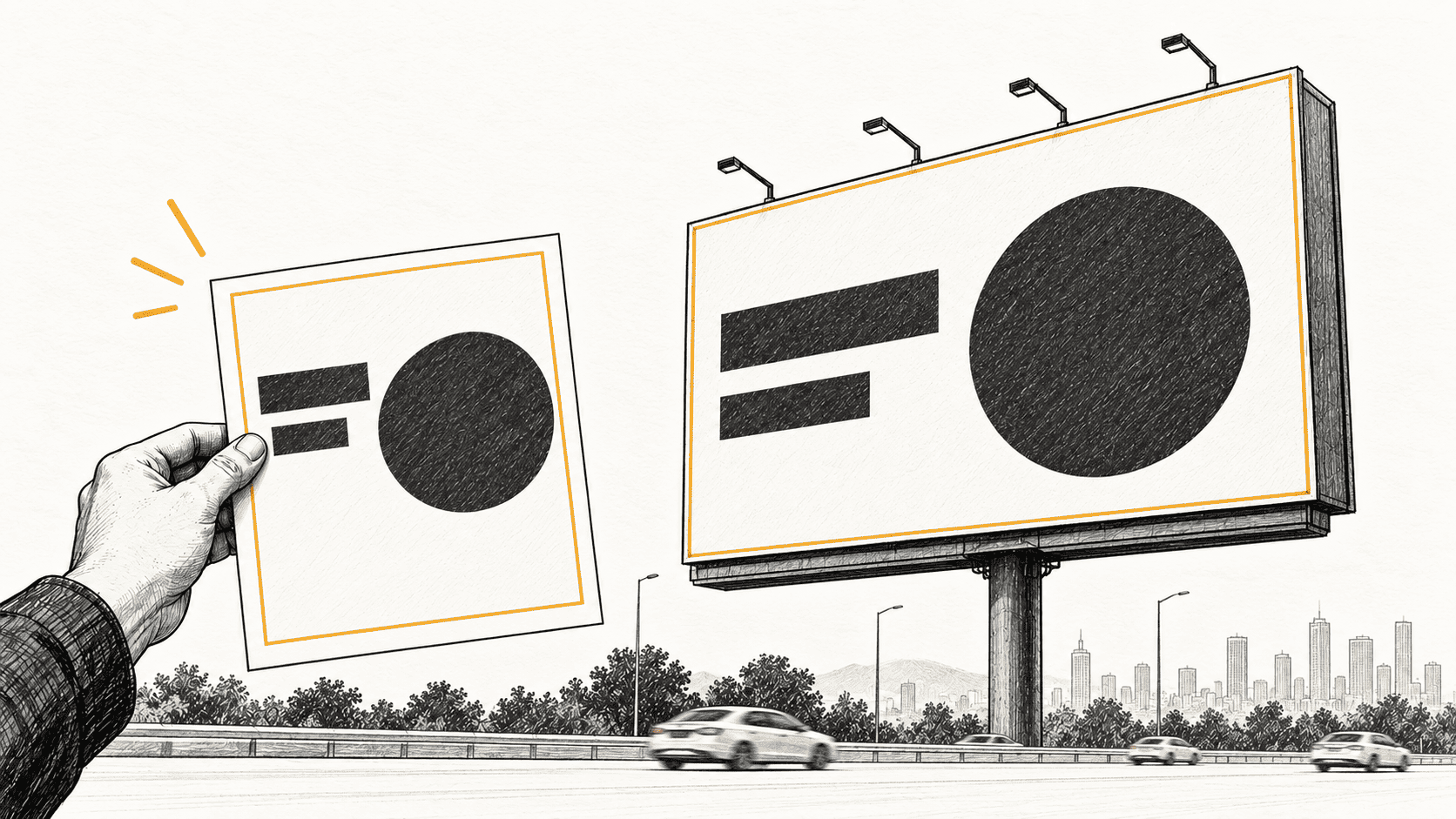
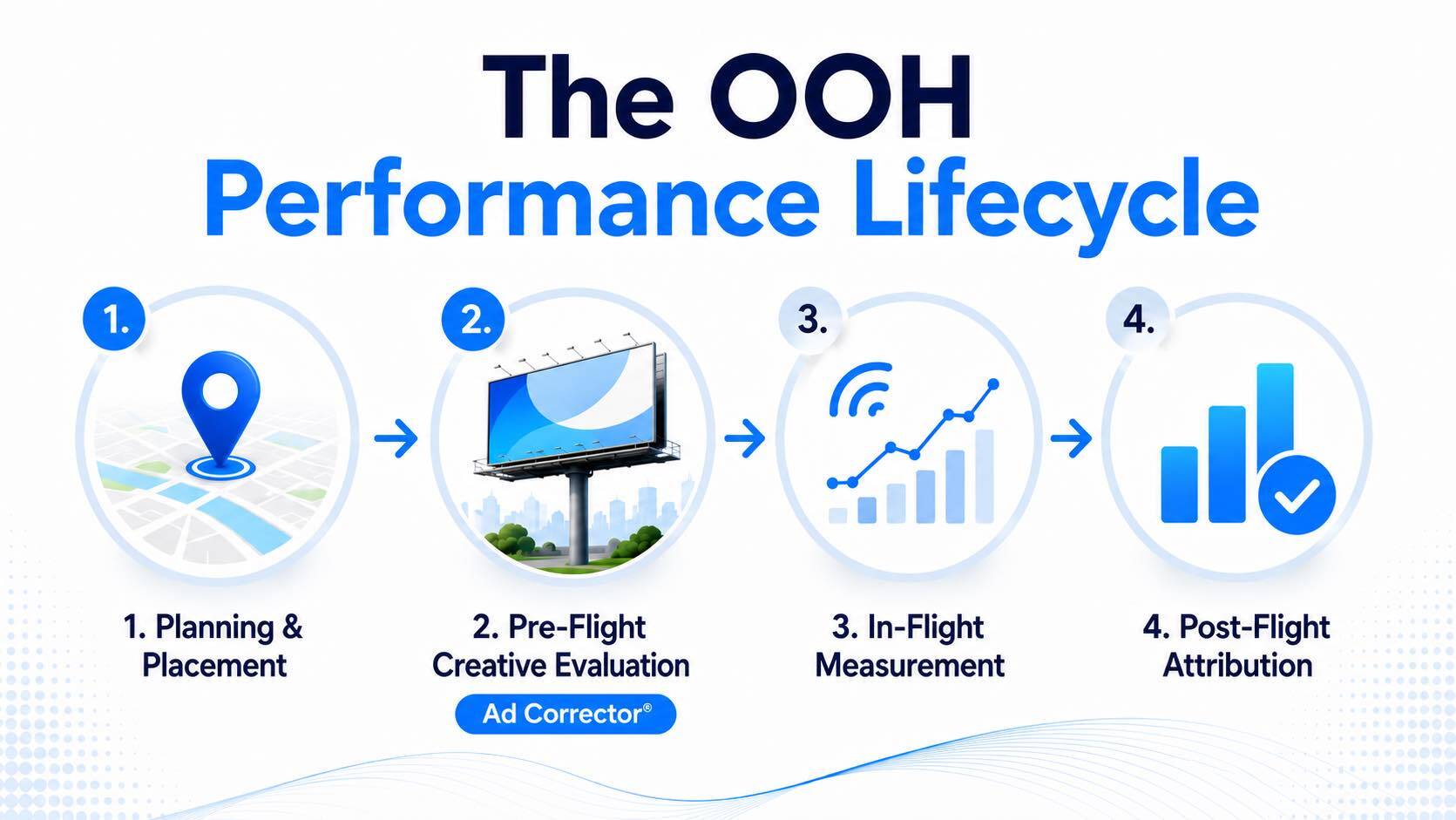
OOH framework
How planning, creative evaluation, measurement, and attribution fit together.
Explore the framework →
OOH analysis
What familiar imagery reveals about recognition, clarity, and smaller advertisers.
Read the analysis →A practical reference for reviewing outdoor advertising creative before launch, focused on clarity, legibility, and fast message comprehension in real-world viewing conditions.
Why the hallway test creates false confidence for readability.
Popular creative evaluated using objective clarity metrics. Billboard ads analyzed for readability, message density, and visibility at highway speeds.
Published: March 15, 2026
See how stripping away clutter and testing visual density raised the modeled CTA score from 68% to 85% in an illustrative multi-round OOH test.
Published: January 31, 2026
How distance, speed, hierarchy, and contrast determine whether creative survives real-world viewing, and why “rule-breaking” sometimes still works.
Published: January 16, 2026
Five publicly visible billboards tested using the same Ad Corrector analysis flow: grade, scores, attention heatmap, speed view, plus what’s working and top fixes.
Tested on: December 4, 2025
AiDigital featured this Absolut Juice billboard. We tested readability and clarity using Ad Corrector. See how it performs at driving speeds.
Published: December 18, 2025
OOH can’t be skipped, but it can be ignored. Why “unskippable” is not a performance guarantee, with a real transit shelter case study.
Outdoor creative has one job: get your message seen and understood in seconds. Most designs fail because text does not hold up at distance or speed, contrast is weak, or layout pulls attention in the wrong direction.
Ad Corrector gives you a simple way to test before you print or launch so readability issues are caught early.
Use the OOH education hub for the why and the how. Then run a free outdoor ad test when you are ready.




Also mentioned in independent product roundups, including IndieProducts.io