What Is a Saccade?
Definition: A saccade is a rapid, ballistic movement of the eye that changes the point of fixation. It is the fastest movement the human body can produce. In the context of Out-of-Home (OOH) advertising, it refers to the jump a driver’s eye makes from the road to your billboard.
The "Blind" Jump (Saccadic Suppression)
This is the most critical concept for designers. During a saccade, the optic nerve effectively shuts down visual processing. This phenomenon, known as saccadic suppression, prevents you from seeing a motion blur of the world as your eyes move.
Why It Matters
• You are blind while moving: The driver does not see your ad while looking toward it. They only see it after they land on it.
• The Energy Cost: Saccades consume mental energy. The brain is lazy; if the peripheral vision does not promise a reward (high contrast), the brain will not command the saccade.
• The Energy Cost: Saccades consume mental energy. The brain is lazy; if the peripheral vision does not promise a reward (high contrast), the brain will not command the saccade.
The Scan Path
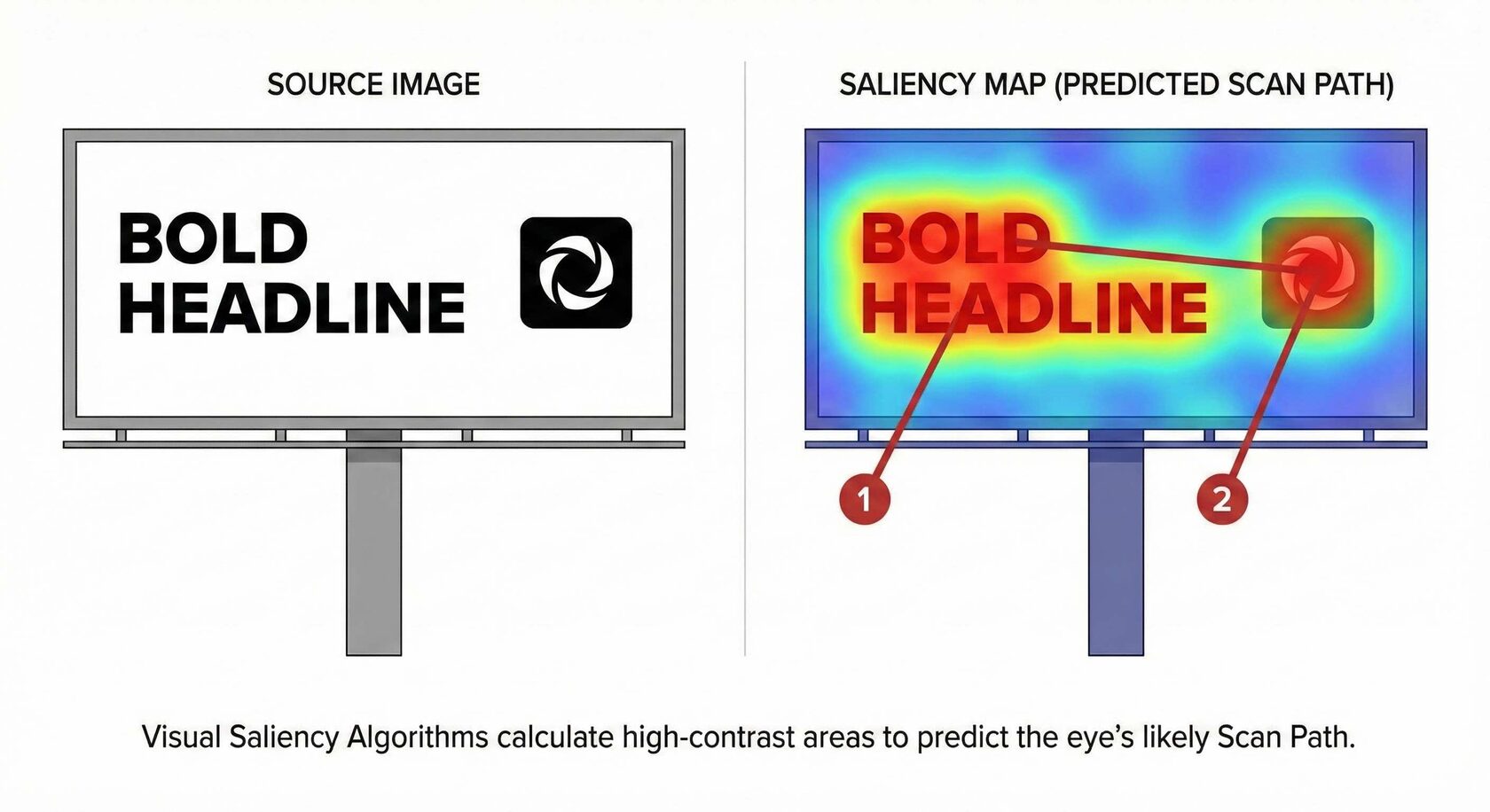
A series of saccades creates a "Scan Path."
1. Entry Point: Usually high contrast or a face.
2. Saccade 1: Jump to the logo?
3. Saccade 2: Jump to the CTA?
If the distance between these elements is too great, the eye may "bounce off" and return to the road before finishing the message.
1. Entry Point: Usually high contrast or a face.
2. Saccade 1: Jump to the logo?
3. Saccade 2: Jump to the CTA?
If the distance between these elements is too great, the eye may "bounce off" and return to the road before finishing the message.
How to Predict Saccades
You do not need eye-tracking hardware to predict where an eye will jump. Saccadic movement is largely deterministic based on Visual Saliency Algorithms.
These algorithms calculate the "pull" of every pixel based on three immutable optical properties:
1. Luminance Contrast: The difference in light intensity (bright vs. dark).
2. Color Opponency: The clash of complementary colors (e.g., Red vs. Green).
3. Orientation: The density of edges and lines.
By mathematically mapping these values, you can generate a Saliency Map. This map predicts the "Scan Path" based on the physics of the image itself, identifying exactly which elements have enough energy to trigger a saccade and which do not.
These algorithms calculate the "pull" of every pixel based on three immutable optical properties:
1. Luminance Contrast: The difference in light intensity (bright vs. dark).
2. Color Opponency: The clash of complementary colors (e.g., Red vs. Green).
3. Orientation: The density of edges and lines.
By mathematically mapping these values, you can generate a Saliency Map. This map predicts the "Scan Path" based on the physics of the image itself, identifying exactly which elements have enough energy to trigger a saccade and which do not.
Ready to Test Your Billboard Design?
OOH Pre-Flight Creative Checklist
Opens in a new tab. Print-ready.

Author: Dan Resnikoff