What Is Foveal Vision?
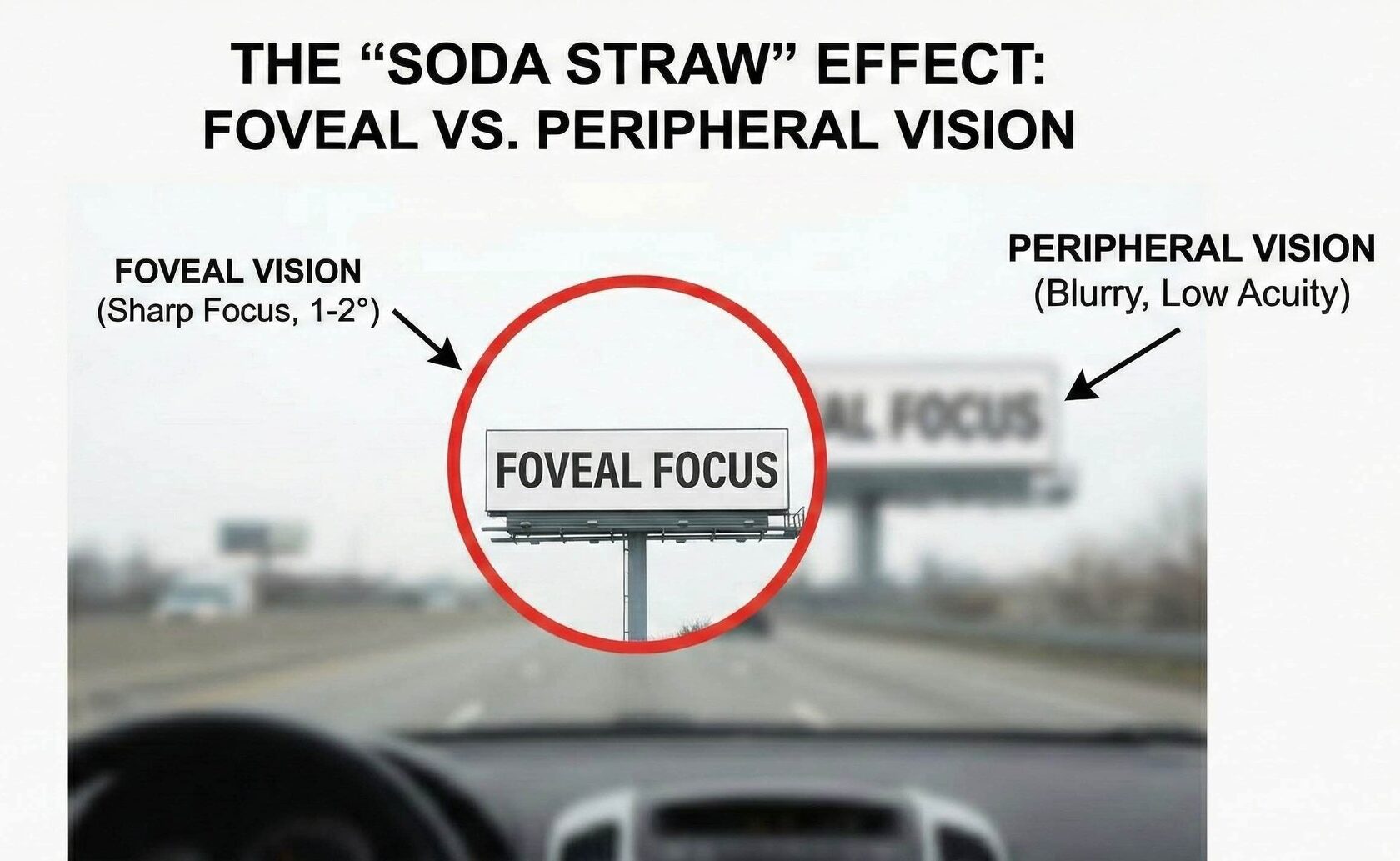
Definition: Foveal Vision is the center 1 to 2 degrees of the human visual field where 100% visual acuity exists. It is produced by the fovea centralis, a small pit in the retina packed with high-density cones.
The "Soda Straw" Effect
For a driver, Foveal Vision is roughly the size of a quarter held at arm's length.
Everything outside this tiny circle is considered Peripheral Vision, which is blurry and functionally color-blind to fine detail. You can think of it like looking through a soda straw: you only have high resolution in that tiny circle, and you have to move the circle around to build a complete picture.
Why It Matters
Designers often assume drivers see the whole billboard at once. They do not.
• The Spotlight: The driver is looking through a "spotlight" of clarity.
• The Hunt: They must move this spotlight around the board to piece together the message.
• The Requirement: Text must be large enough to be identified by peripheral vision first, so the eye knows where to aim the foveal spotlight.
Everything outside this tiny circle is considered Peripheral Vision, which is blurry and functionally color-blind to fine detail. You can think of it like looking through a soda straw: you only have high resolution in that tiny circle, and you have to move the circle around to build a complete picture.
Why It Matters
Designers often assume drivers see the whole billboard at once. They do not.
• The Spotlight: The driver is looking through a "spotlight" of clarity.
• The Hunt: They must move this spotlight around the board to piece together the message.
• The Requirement: Text must be large enough to be identified by peripheral vision first, so the eye knows where to aim the foveal spotlight.
Foveal vs. Peripheral Hierarchy
The human eye follows a strict biological hierarchy when scanning a roadside environment:
1. Peripheral Job: Detect contrast and shape. "Something is there."
2. Saccade Job: Move the eye to that spot.
3. Foveal Job: Read the text. "It says 'Eat Here'."
If your text is too small, the fovea cannot resolve it quickly. If the contrast is too low, the peripheral vision never detects it, and the fovea never visits it.
1. Peripheral Job: Detect contrast and shape. "Something is there."
2. Saccade Job: Move the eye to that spot.
3. Foveal Job: Read the text. "It says 'Eat Here'."
If your text is too small, the fovea cannot resolve it quickly. If the contrast is too low, the peripheral vision never detects it, and the fovea never visits it.
How to Quantify Peripheral Visibility
To determine if your design will trigger foveal vision, you must measure its Spatial Frequency.
The scientific method is to apply a Low-Pass Filter (a specific optical blur) to the image. This removes the fine details that the peripheral eye cannot see. If your headline and logo are still recognizable after this filtration, they have high "signal strength" and will successfully command the driver's attention.
The scientific method is to apply a Low-Pass Filter (a specific optical blur) to the image. This removes the fine details that the peripheral eye cannot see. If your headline and logo are still recognizable after this filtration, they have high "signal strength" and will successfully command the driver's attention.
Ready to Test Your Billboard Design?
OOH Pre-Flight Creative Checklist
Opens in a new tab. Print-ready.

Author: Dan Resnikoff